DOMELGABOR: ECHOES OF THE DRUM - A spiritual, melodic Afro House track featuring prominent percussion and drums
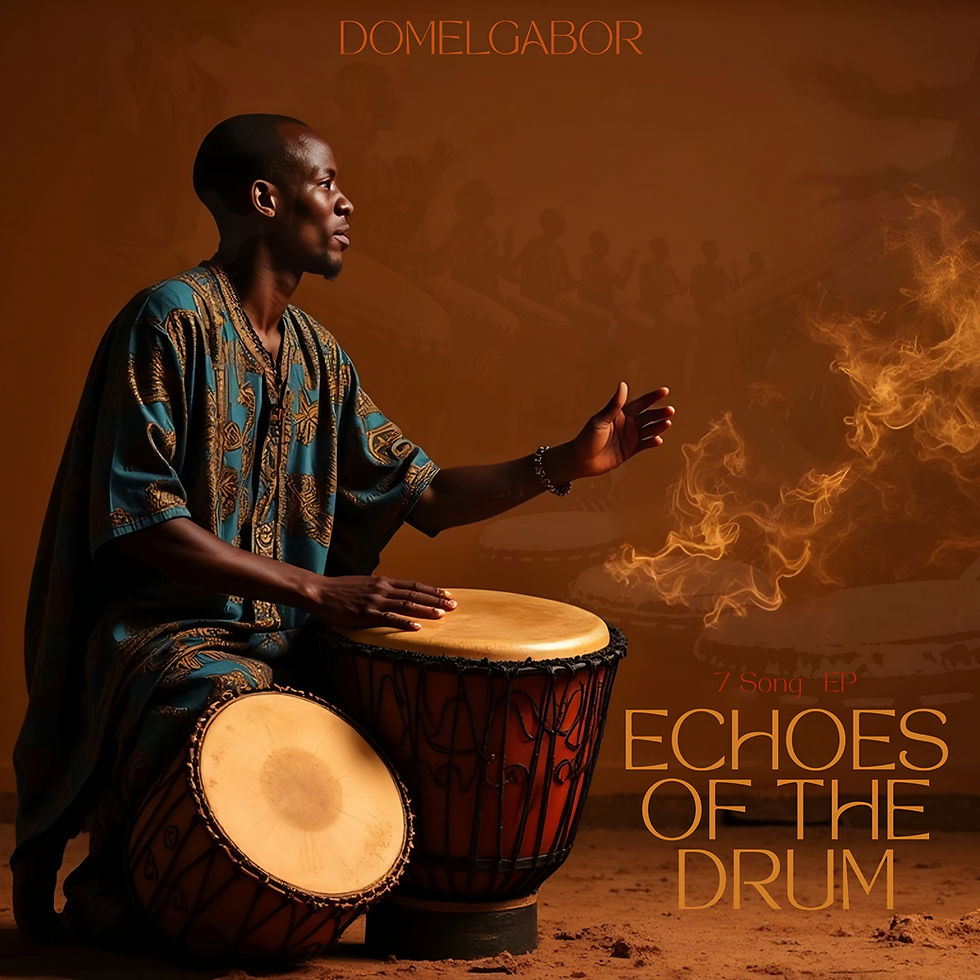
DOMELGABOR: ECHOES OF THE DRUM - A spiritual, melodic Afro House track featuring prominent percussion and drums
ECHOES OF THE DRUM is a spiritual, melodic Afro House track featuring prominent percussion and drums, with lyrics about an African tribal drum gathering.
The beginning of the music
If you've been following me for a while, you know there is a spiritual side to most of my songs. A connection to our earth, the oceans, the seas, the forests, the mountains, the sun, the moon, the stars, and the universe, is omnipresent in my lyrics and my music. And what's more spiritual and ancestral than the percussion and drum?
Percussion instruments are musical instruments that produce sound when struck, shaken, scraped, or rubbed. Believed to be the oldest musical instruments in human history, they form the "heartbeat" of a musical ensemble, providing essential rhythm, pacing, and dynamic energy.
Music began long before recorded history, growing out of the natural sounds, rhythms, and voices of early human life. The human voice was the first musical tool, long before physical instruments existed.
As we do today, early humans copied sounds from nature, such as birdsong and animal vocalizations (like barks, moos, or chirps). Mimicking animal sounds and vocalizations is called onomatopoeia. Onomatopoeia is a figure of speech in which a word phonetically imitates, resembles, or suggests the sound it describes. Examples include animal noises (meow, oink, moo, chirp), impact and action (bang, crash, thud, splash), and household and object sounds (tick-tock, beep, drip, clang).
Alongside the voice and imitated sounds, came the body's rhythm. People made rhythmic beats using hand clapping, foot stomping, and slapping stones (as well as their chest and thighs), probably reproducing some of nature's rhythms and sounds.
Music became a reason for social bonding, often used in gatherings and rituals, bringing groups and families together to cooperate and build community. Scientists also believed it served as a means of communication, as musical tones and variable pitches preceded formal human speech. Meanwhile, it also became a vehicle for expression and emotion, as early people used chants and sounds for healing, storytelling, spiritual rituals, and expressing deep emotions.
Then came some of the earliest musical instruments humans invented, such as bone flutes and simple percussion instruments. Archaeologists found ancient flutes made from bird bones and mammoth ivory in Germany that are over 40,000 years old. Probably around the same period, or not long after, percussion instruments, including simple drums, rattles, and hollow logs, also spread across cultures worldwide.
And that's how, by humming, whistling, voicing, striking, shaking, scraping, rubbing, and slapping, music was born, and rhythm became a prominent feature of our daily life.
Rhythm, and therefore music, can be found in every sound we hear everywhere around us.
The inspiration behind the song
I have always loved the sounds of drums and percussion and how they affect the body. You've surely noticed that some sounds and music featuring them immediately make you want to move, whether it's a slow, balancing movement or a very intricate dance. And that's what I'm talking about: this inherent ability of rhythm and music to affect our body and soul. You don't know why. You can't even explain it. And yet it instantly sparks something in you. It even makes you happy, changes your mood, and liberates you from stress and anxiety, as the only thing you care about in that moment is to move or even dance and express yourself freely.
That's why people love raves, festivals, concerts, and other music gatherings: they know everyone has come to feel and enjoy the music in their own way, without fear of judgment, united by the sounds and moving with the rhythm.
In most songs, the drums and percussion carry the rhythm, providing the core pulse, energy, and structural foundation that hold the entire piece together. They provide the rhythmic foundation and timekeeping by setting the tempo, keeping the band in sync, and anchoring the groove. They also bring energy and dynamic contrast by building tension, driving intensity, and adding emotional weight, while defining the songs' genre and identity, as well as textures, flavors, and culture, with traditional instruments such as Latin bongos, West African djembes, or Indian tablas, for example, infusing a song with distinct cultural roots and unique rhythmic flavors.
And speaking of West African Djembes, I have always been fascinated by this rudimentary yet complex instrument. I mean no offense when I say "rudimentary," but it's true: this rope-tuned, goat skin-covered goblet hand drum, originating in West Africa, was invented centuries ago and, despite some recent synthetic-skin versions, has remained as traditional as it was then.
According to the Bambara people (also known as Bamana or Banmana), a major Mandé ethnic group native to West Africa and the largest ethnolinguistic group in Mali, the name comes from the phrase "Anke djé, anke bé," meaning "everyone gather together in peace."
Although I have always been fascinated by African Culture, and have some African friends, as well as being married to an African American woman who gave me two beautiful mixed-race kids, I have never been to Africa.
However, I have seen many documentaries and scenes in movies and series about African drum gatherings, which usually represent a communal event where people play percussion to unite the community, celebrate milestones, and connect with ancestors. I have also attended and watched several drum gatherings, commonly known as a drum circle, which are informal public events where people come together to play hand drums, percussion instruments, and dance in a shared rhythm. And I have always immensely enjoyed them.
This idea of drum gatherings where people exchange, share, play, chant, laugh, and dance in peace, all tied around the rhythm and the music, inspired me to write the lyrics and create the music for this song featuring lots of percussion and drums and sounding like a drum gathering with spiritual vibes.
The process behind the song
As I always do, I started by writing the lyrics. It is a painful process that can take me a few hours to a few days: first writing the intro, verses, chorus, and outro, then refining them to make sure they flow well together and/or tell a continuous story, encouraging the audience to want to listen to the lyrics until the end of the song.
Then, as you know by now, I compose the music fully or partly using a keyboard, loops, and a DAW, and/or I use AI to create the music and voices fully or partly. Although I write 100% of the lyrics myself, as they tell stories, situations, and opinions with my words and my way of speaking (as an ESL - English as a second language), depending on my mood and what I want to hear or what I'm experiencing at the moment of writing, I need to be honest: I have been using AI more frequently this past year to create the music and voices.
I can already hear some of you saying I shouldn't use AI and should learn to play one or more instruments, because it is better for the planet, people, animals, plants, the climate, and the environment in general. And I agree because it's hypocritical for me to write lyrics about nature, the planet, the environment, and the world's conditions and situations, and hope for a better future for humanity and the world in general, while still using AI. I agree, and I do not argue against that.
However, learning an instrument is easier said than done; not "everyone can learn." Especially for a guy like me. Because I have never been well-coordinated with my hands, consequently, it is almost impossible for me to play an instrument well, as I cannot dissociate my left from my right hand. This means it is very difficult for me to do something with my left hand and something else with my right hand at the same time. Same for my feet. So I can forget about learning guitar, piano, or drums, for example, even if I still try with the instruments we have at home (such as an acoustic guitar, an electric bass, a keyboard, a piano, and a ukulele).
At the end of the day, I'm a lyricist, not a musician, and I'm not pretending to be one either. I love writing stories, essays, and poems, expressing my opinions and views on a broad spectrum of subjects, and putting them into songs.
I also like to think of myself as a "producer," as the way I create my songs isn't so different from that of a real producer or band. Ok, it is easier to cut and paste the lyrics I wrote into an AI, then write a prompt to create the music style, genre, and voice, but it's not so different from what a real producer or band does. The AI does it faster.
Hear me out. A real producer or band writes the lyrics and music for a song, but then they have to refine the lyrics, fine-tune the music to what they want, and find the voice and right way to sing it through weeks of rehearsal and trial and error until they're satisfied. Right?
Well, that's exactly what I do with AI, except it takes only a few hours to a few days, instead of weeks or months. I write my own lyrics, choose a title, write a prompt with the music genre, style, and ambiance I want for the song, write detailed tags to guide the AI (Pause, interlude, build-up, etc.), then press create to get different versions of the song. Now the hard part is carefully listening to all the versions to define the right voice, music style, and how it is sung until it sounds right to my ears and I'm satisfied.
Too easy for you? Do it then. Try, and you'll see what happens. It may seem simple, but it isn't; trust me. Especially when you know that most AIs do what they want and often add unwanted elements such as noise and static, humming, distorted sounds and voices, or mispronounced words, and more, which oblige you to create more versions and/or get the stems to clean up the song through a DAW, and in most cases, remaster it once or twice to obtain a decent song. It is a painful, frustrating process.
From Single to EP
For this song, "ECHOES OF THE DRUM", I created more than 15 versions. I liked 7 of them to the point that I could not discard them, even if some presented obvious flaws such as saturation, noise, and static, especially towards the end of the songs, that I had difficulty masking or attenuating even after remastering them a few times.
So, that's how "ECHOES OF THE DRUM" became an Album EP with 7 versions of the same song, rather than one single. Each has its own genre, style, and identity, and the lyrics also differ slightly from one another. All have spiritual, melodic Afro House vibes, with lots of percussion and drums.
ECHOES OF THE DRUM (Spiritual Healing)
ECHOES OF THE DRUM (Spiritual Groove)
ECHOES OF THE DRUM (A Tribe Calling)
ECHOES OF THE DRUM (Calling All Tribes)
ECHOES OF THE DRUM (African Savanna Choir)
ECHOES OF THE DRUM (Live African Gospel Praise)
ECHOES OF THE DRUM (Live African Gospel Choir)
The lyrics of "ECHOES OF THE DRUM"
The following lyrics are from the "ECHOES OF THE DRUM (Calling All Tribes)" version.
Listen
Can you hear it?
The rhythmic thump
The steady pulse of a heartbeat
You first heard it in the womb
Now it is shaking the room
Awakening emotions and sensations
From joy to deep introspection
A spiritual connection
An ancient tradition
Let the rhythm move your soul
Let your body lose control
The dust is rising from the floor
The rhythm's knockin' at your door
You start to get carried away
The night is swallowing the day
Can you feel it in your chest?
The pulse that never lets you rest
Leave the heavy world behind
And let the frequency align
Oh-lay-la
The sun is gone
Oh-lay-la
The night has begun
Oh-lay-la
The drum has come
Oh-lay-la-la
We become one
Oh-lay-la
The sun is gone
Oh-lay-la
The night has begun
Oh-lay-la
The drum has come
Oh-lay-la-la
We become one
Listen to the beat!
Listen to the drum!
Do you feel the heat?
All over your body
We become one
Let's rave this party
Fire burning in the night
Moving till the morning light
Ancestors in the melody
Setting every spirit free
Hum, no need to say a word
The loudest voice you've ever heard
Is breathing inside the kick
Watch how the elements click
Oh-lay-la
The sun is gone
Oh-lay-la
The night has begun
Oh-lay-la-la
Oh-lay-la
The drum has come
Oh-lay-la-la
We become one
Oh-lay-la
The sun is gone
Oh-lay-la
The night has begun
Oh-lay-la-la
Oh-lay-la
The drum has come
Oh-lay-la-la
We become one
Listen to the beat!
Listen to the drum!
Do you feel the heat?
All over your body
We become one
Let's rave this party
The world is quiet now
Yet the ground is shaking
With a new vibration
That we are making
We are dancing in the dark
We just wait for the spark
Can you feel it
Can you feel it
Build up the fire
Build up the light
Build up the rhythm
We Own The Night
Oh-lay-la
The sun is gone
Oh-lay-la
The night has begun
Oh-lay-la-la
Oh-lay-la
The drum has come
Oh-lay-la-la
We become one
Oh-lay-la
The sun is gone
Oh-lay-la
The night has begun
Oh-lay-la-la
Oh-lay-la
The drum has come
Oh-lay-la-la
We become one
Listen to the beat!
Listen to the drum!
Do you feel it?
Look, everybody
We become one
We've raved this party
We become one
Song Title: "ECHOES OF THE DRUM (Calling All Tribes)"
Lyrics: DOMELGABOR (aka Dominique B S Noel)
Music and vocals: AI-generated (partly or fully)
Where to listen to the EP "ECHOES OF THE DRUM" by @domelgabor
"ECHOES OF THE DRUM" EP by @domelgabor is now available on YouTube, Spotify, Apple Music, and soon on most music platforms.
YouTube: Listen here
Spotify: Listen here
Apple Music: Listen here
Thank you
As always, thank you for your ongoing support and for listening to my songs and tracks. It means the world to me.
Peace!
Dom
@domelgabor #domelgabor @domelgabor_music #domelgabor_music #echoesofthedrum #afrohouse #worldmusic #spiritual #drumgathering #joyful #uplifting #peaceful #together #gathering #united #drum #percussion Song, New release, Domelgabor, Domelgabor Music
Unless otherwise stated, all rights reserved ©Domelgabor 2026 to all the content above, including, but not limited to, photos, pictures, drawings, illustrations, collages, visuals, maps, memes, posts, texts, writings, quotes, lyrics, notes, tasting notes, descriptions, song descriptions, definitions, recipes, graphs, tables, and even music and video (when and where applicable).


Comments